
Bear Facts: Learn about Grizzlies and How to Avoid an Attack!

Soft beams of faded evening light sift through the leaves of the highest branches and filter down amongst the watchful tree trunks. The daily chatter of the forest's small inhabitants has died down to the whisper of the few birds whose voices have not yet grown tired. A breeze finds its way into the gloom of the undergrowth, rustling the dry leaves like the roar of a waterfall 1,000 times reduced. Without warning, the sharp sound of a snapping twig bounces into the sky and percolates through the sunset light, rebounding back and echoing into the darkest hollows of the wood. The late birds stop their song. The first cricket to purr into the night cuts his chirp in half.
Another snap. The barely perceptible crunch of a padded paw pressing into dead leaves. The snuffle of an oversized nose . . .
With the scientific name Ursus aectos the grizzly bear is one of the largest mammals on earth, growing up to 5.5 feet tall and 1,700 pounds. Even one paw print can be 14 inches across, often showing the marks of 4-inch long claws (Tekiela, 343). Learn about – the grizzly bear!
Hibernation: The grizzly bear is not a true hibernator due to the fact that it remains fully awake for its 6-month winter. That being said, the grizzly does remain in a den for this period, sometimes moving about but never eating. Before winter, the bear must gain up to 450 pounds in body weight to prepare for a winter with no food. A hibernating grizzly can be irritable and should not be approached (Tekiela, 345).

Characteristics: The grizzly can range in color from yellow-brown to black, but its white-tipped hairs are what give the bear the appearance for which it is named. Due to the range of coloration, grizzlies can be confused with black bears (Ursus americanus), but the grizzly bear’s larger size and distinctive shoulder hump are the biggest differences (Whitaker 555).
A grizzly bear will claim and area and guard it against invading bears; the largest individuals protect the choicest land. Along salmon rivers, particularly in Alaska, USA, bears become aggressive and vicious. Fights can break out over the best fishing spots. It may be surprising that for such a large, intimidating creature, grizzly bear’s cubs are born at only about a pound, or the size of a large rat (Whitaker 557).
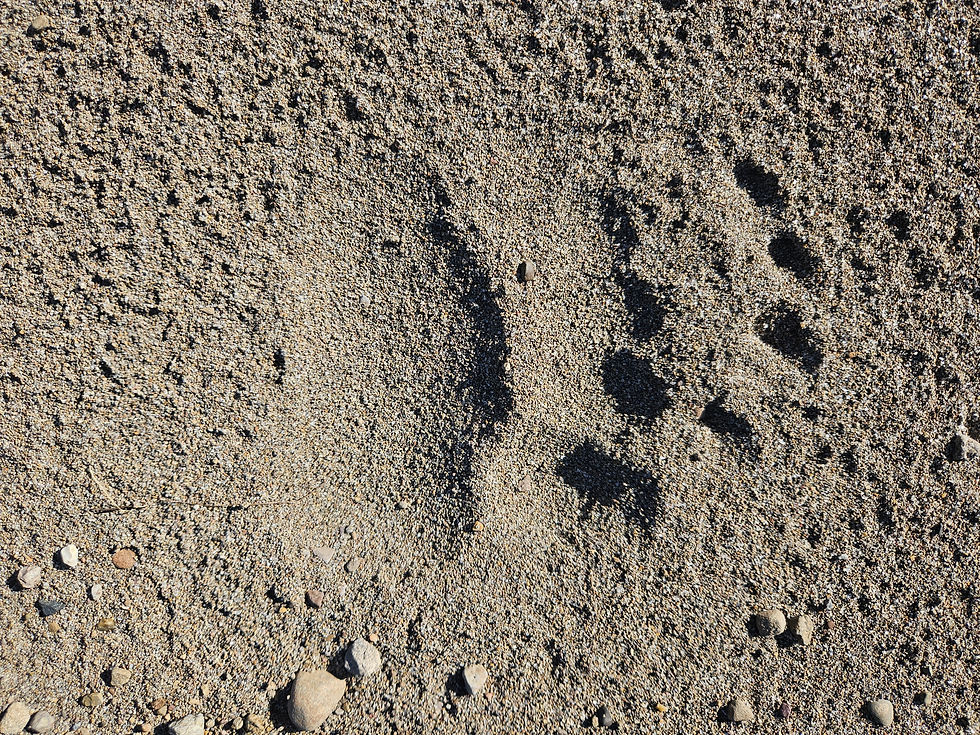
©2026 by Jenny Venturo Grizzly bear front paw track. Notice the long claw marks
Signs: Beware of any shallow depression in the woods heaped over with debris: this often conceals a bear’s half-eaten kill or carrion and the animal will not be far off. Grizzlies will return to one food cache until only the bones are left. Other signs of bear activity include claw marks on trees that can be two times the height of a grown man or beds in thickets measuring 3 feet by 4 feet and I foot deep (Whitaker 555).
Notes: While grizzlies are mostly nocturnal, they can be seen in the day, and you should keep far away from them any time you encounter them. Cubs one year old lose their ability to climb trees, yet even grown bears can run as fast as a horse (Whitaker 556).
As an omnivore, the grizzly bear eats both plants and animals, but its main food is green plants. Besides these and live animal prey, the grizzly will eat berries, fruit, nuts, and carrion (Tekiela 345).

The forest is now just barely lit, and the small creatures in it seem to be holding their breaths. The shaggy form silhouetted in front of a clearing lowers its head and begins slowly swaying as it ambles toward a rotting log. Sounds of snuffling and grunting greet the night, and as the golden moon rises behind an ancient spruce, the forest seems to regain its nightly repose. A bear is having his breakfast.
When hiking or camping in bear country, there are a few things you can do to avoid an encounter. For one thing, no one should ever hike alone; stay with your group at all times. A bear is more likely to attack a single hiker than a large group. Purchase bear spray and make sure you know how to use it (Wind River Range South: Lander, Cirque of the Towers).
If you are planning a camping or backpacking trip in bear country, food storage is a concern. Some established campgrounds offer storage cabinets at each site. Put anything a bear might smell into these boxes. When no site is available, like in the backcountry, there are several ways to keep bears from your food. First of all, never keep food in your tent. Even crumbs can attract bears to your sleeping area. Bear resistant canisters and Ursacks (lightweight bags for food storage) are the most effective means of protecting food. Keep these far from your tent. Another method to store food is to hang it out of reach of bears. Hang a stuff sack from a branch 15-20 feet high and 4 feet from the tree trunk.

Hanging bear bags
At each campsite in the backcountry one area should be elected for eating and cooking. Keep a lookout when eating and pack up any food if a bear is seen. After each meal, use soap to wash the dishes and dump the water downwind of your campsite. Dishes and stove fuel should be kept with your food (The Mountaineers 57).
Whenever I see a grizzly bear, I can’t help but think of power. The power of its limbs as it tears open a log. The strength of its paws as it pads along the ground. Once, I saw a grizzly flip a large log with one swipe of its paw.

In the same way, God is powerful. He’s got this. He is able to get us out of trials and put us into them. If we have already repented of sin and believed in Jesus, then our job is to trust God because He knows what He is doing. We may never know why, but we know what we know: we can trust God’s Word through anything and we must obey it in everything (Psalms 119:160; Romans 8:28).
Read here about our encounter coming face to face with a real live grizzly bear!
Want to watch a grizzly bear in action?
Photos by Jenny, Daniel, and Joshua Venturo.
Works Cited
Tekiela, Stan. Mammals of Colorado Field Guide. Adventure Publications, 2007.
The Mountaineers. Mountaineering: The Freedom of the Hills. Edited by Eric Linxweiler and Mike Maude. 9th ed., Mountaineers Books, 2017.
Whitaker, John O., Jr. The Audubon Society Field Guide to North American Mammals. Alfred A. Knopf, Inc., 1980.
Wind River Range South: Lander, Cirque of the Towers. National Geographic, 2021. Map.

