
Learn the 5 Classes of Climbing!

The summit loomed ahead of us, jutting into the sky like a fearsome fang. My heart raced as I tightened my helmet and took a step forward. We were doing this.
I gripped the rock with my hands and tested my footholds for anything loose. I knew that one wrong move or misstep would send me plummeting hundreds of feet down to the bottom of the mountain. I concentrated on gripping the rock and pushing my body up.
Then, suddenly, we were there! I scrambled over the last few rocks to the top. A great shout of “We did it!” rose from everyone’s lips. I breathed a contented sigh and looked around at the views. We had done it.
We had been researching and preparing for Wetterhorn Peak in Colorado for weeks. We had been exercising our muscles for pushing and pulling up the rocks. We had packed our bags with layers, food, and helmets. And we had researched. We had looked at pictures of the route and what people had to say about it. And, of course, we knew that this peak was a Class 3.

The Class 3 summit pitch on Wetterhorn Peak, Colorado
One of the most important things a mountaineer must know before he sets out is how difficult the climb is. Climbers have set up a system to make it easier to determine the difficulty of a mountain.
Class 1: Class 1 is hiking on a trail to the summit of a mountain. Mount Elbert, Colorado, is a good example of Class 1 (Roach xiv-xvi).

A Class 1 hiking trail

Mt. Elbert, Colorado
Class 2: Class 2 constitutes off-trail hiking and light scrambling (Roach xvi). Most fourteeners in Colorado are Class 2.

An example of a Class 2 mountain. This is Horn Peak in the Sangre de Cristo Range of Colorado
Class 3: Class 3, which marks the beginning of rock climbing, is defined by rock scrambling with easy handholds and footholds, although these holds may be loose. Peaks like Wetterhorn and Sneffels in Colorado are classified as Class 3 (Roach xiv-xvi).
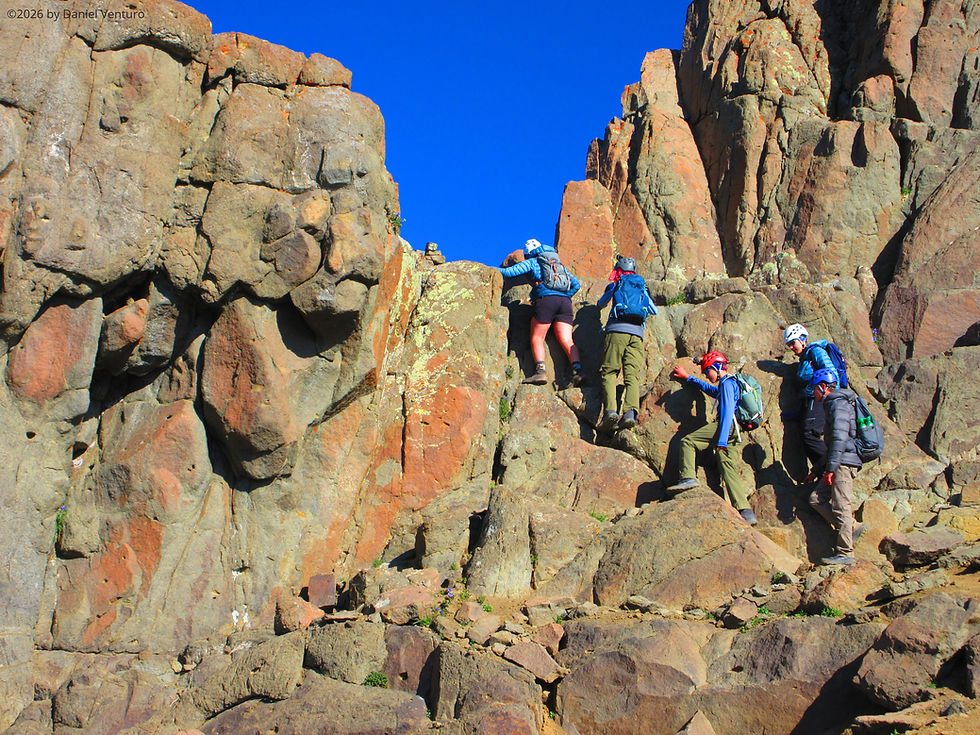
Another Class 3 pitch on Wetterhorn Peak, Colorado

Another Class 3 mountain we have climbed. This is the Southwest Ridge of Mt. Sneffels, Colorado

More Class 3; descending the standard route on Mt. Sneffels
Class 4: Class 4 is difficult rock scrambling, and this is where some people start using technical gear, like ropes (Roach xvi). Colorado’s hardest fourteeners are Class 4.

We got off route on Mt. Sneffels, Colorado, and found ourselves on a Class 4 section

The Crestones, Colorado. The peak on the left is the Crestone needle, a Class 4 mountain that we would like to climb someday
Class 5: Class 5 is technical rock climbing, requiring ropes and anchors (Roach xvi). None of Colorado’s fourteeners are Class 5 on the easiest route.

Tea Kettle Mountain, Colorado. This is an example of a Class 5 peak

A Class 5 move
Like mountains, the Christian life has different difficulties along the way. Sometimes, the going feels like a Class 1 trail hike, where we easily walk along without any worries. Other times, it feels like we are on a Class 5 wall, with nowhere to place our hands and feet. In either case, Jesus is right there, leading and guiding and helping. He is beside us on the Class 1 trail as well as the class 5 wall. He is there to catch us if we stumble and hold us up when we are weary. He is the Anchor to attach our rope to. And He will be there at the summit, when we finally see Him face to face (Psalm 46:1, 54:4, 124:8; Hebrews 6:19).

Dad, having fun on Little Horn Peak, Colorado
Photos by Jenny, Paul, Daniel, and Joshua Venturo
Information from: Roach, Gerry. Colorado’s Fourteeners: from Hikes to Climbs. Chicago Review Press, Inc., 2022


